Saturday, January 11, 2014

Peru, Ancient People, Myth, Legend, Centuries Old Ruins, Pisco, & Ceviche - Part I Chiclayo the North


Part I: the North – Chiclayo and surrounding area

Peru, a country we traveled from north to south and the Andes in between, leaving only the jungle unexplored by us.  (We had seen the jungle while in Ecuador, see “We survived the Amazon”)  We wanted to visit pre-Inca civilisations, their architecture, and learn of their culture.  Nowhere is there more of this than in Peru.    Mexico and Central America have the Mayans, Peru and South America have the Incas. 

It has been an amazing journey sailing Limbo from New Orleans to Lima.   Not many sailors come this far south, for several reasons,  the primary one being head winds.  Very stubborn, strong head winds.  No one likes to sail an extra 400 miles tacking back and forth just to pull into a port that then charges them an exorbitant amount of money to enter their country.  They also tend to threaten you with fines for not adhering to particular guidelines made up as they please.  Had it not been for the Seven Seas Cruising Associations liaison, Gonzalo Rivago, we would have been at their mercy.  This is not so for land travel or people entering by plane.  There are quite a few people that leave their boats in Bahia Ecuador and travel by bus or plane to Peru.  The offset to the government officials is Peru itself.  A country filled with generous friendly people, and lets not forget the food.  Do not come here if you are worried about your waistline.  

Peru has been on my bucket list for quite some time as a place to visit and we both had dreamed of Macchu Picchu.  There is so much more than Macchu, although that is a highlight.  We started our adventures with a bus trip north of Lima, to the bustling city of Chiclayo.  This is primarily a commercial area but also used by tourist as a staging point to visit the sites of TÙcume, SipÃn, Lambayeque, and Batan Grande.  Chiclayo also has a central market famed for its section devoted to  mercado de brujos (witches market) selling everything from herbs to whale bones and the famed San Pedro hallucinogenic cacti. 

We arrived rather early with plenty of time to drop our bags and book a tour.  We got lucky with Sipan Tour company for pricing and a private guide with car.  We were able to make our own schedule with sites we wanted to see.  We went first to La Pimentel,  a small beach community that still uses the traditional caballitos del mar (made from totora reeds) boats for their small fishing industry


 Over the next two days we visited the archaeological sites of SipÃn , Sican, Tucume, and the Bosque de Pomac  a dry forest,  as well as the  Museo de las Tumbas Reales de SipÃn and Museo Nacional de SicÃn and Museo de Sitio.  Tùcume is also known as the valley of the Pyramids with over 26 adobe mounds to walk to.  The dry windy conditions and earthquakes, has left many of these structures looking like large mounds of packed dirt with some crevices and remnants of steps.  Looking closely, bricks could be seen, imaginary rooms with walls, etc.  Much to learn, some quite confusing as to who conquered who and when.  The cultural differences seem to be in their ceramics, religious idols, crafts and burial preferences.  Some were buried laying down, some sitting up.  All seem to be buried with their possessions to take into the after life.  The area was first inhabited by the Mochica where the Temple of SipÃn was the main burial pyramid for the nobles, then SicÃn who built in the BatÃn Grande area abandoning it after a disastrous rain in 1100 AD.  They then moved to Tûcume.  Then came the Chimu people, the Inca, and then the Colonial period.  I think this is the order of it.  A few references,  three museums, and one guide have a little different story for each.  They all furthered  civilization with textiles, ceramics, metallurgy, agriculture, and boat building techniques we continue to learn from and build on.  Of the area we saw, I believe the dry forest was my favorite. 


noble found buried sitting upright with his wife, concubines, child and 2 guards

 Burial Note:  When the husband dies, his wife and his concubines are sacrificed and buried with him.  If the child is under 14 years of age, they too are sacrificed and buried.  The guards are also killed and their feet cut off so they have to stay to protect the tomb for all eternity.  Our guide, Arturo said they were given juice from the San Pedro Cacti and then killed. 
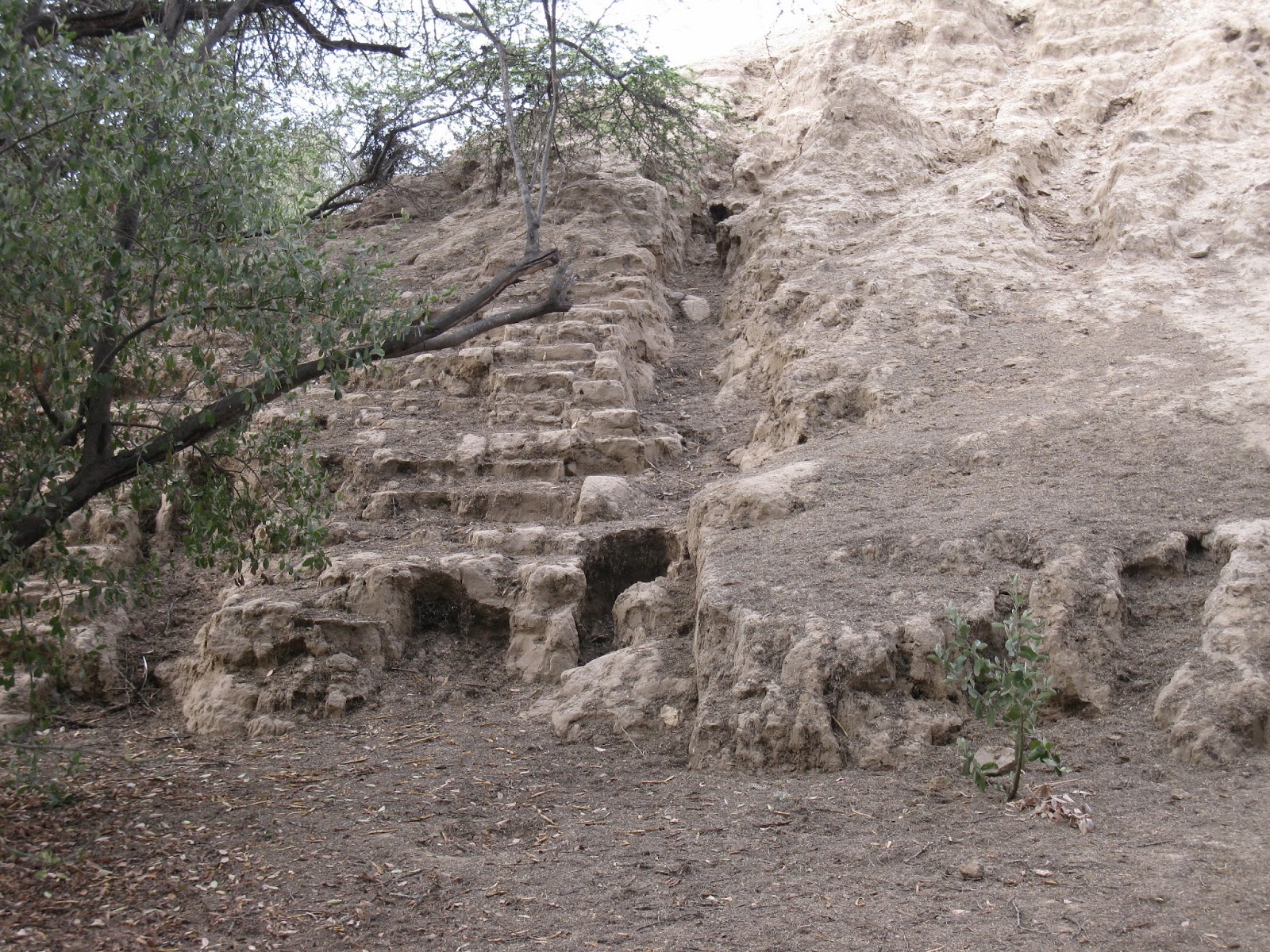


1000 yr old tree and still growing


Arturo told us of a time when he went to Brazil it started to rain.  He had never, yes, never in his life seen rain.  His friend gave him an umbrella and told him to put it over his head so he would not get wet. He was confused as to why people were laughing and staring at him.  He had not opened the umbrella but held it above his head with it closed.


fallen bridge
  When the governor came for the opening ceremony, the bridge collapsed when the first car went over.  The driver had to be rescued and sent to the hospital.  He then was arrested and sent to jail for breaking the bridge.


We spent three days touring the area and went to continue our way to Trujillo.  While waiting in line for a bus ticket, my backpack was stolen, in it my clothes, computer, planner, guide book, and my travel diary.  Yes, I know a few paragraphs back I said what a wonderful people the Peruvians are.  They are.  I don’t want to sully mine or your view with one bad incident.  However, with no clothes, we returned to Lima to regroup and replace things I needed.


Continued Part II

Thursday, January 2, 2014

First week in Chile

The sun is shining and I’m wondering why?  I had looked at my watch and it said 4 a.m.!  Awe, yes, three hour time difference, it’s really 7 a.m.  But wait, the sun is still so incredibly bright.  After four months in Lima, dark had become our day and night.  This was a splendid change even at the early hour. 

We had many things on our “To Do” list.  First was to get pesos, then back to the phone company.  We discovered we had internet for a little while but then we didn’t and we were not able to make calls.  I will not complain, it is still easier to deal with cell phone companies in any of the countries we’ve been to over the ones in the United States.  Agenda day one: Entel, Zofri (a duty free zone), grocery store, laundry, book store.

There are countless banks here in Iquique some of them international.  This was a huge mining town in the 19th century for nitrate and copper.  There are also a few abandoned silver mines dating back as far as the late 1500’s.   They now have a large fishing industry that ships fish meal around the globe and in 1975 they built the “zona franc” locally called zofri.  It is a massive duty free shopping zone offering anything from cars, clothes, electronics, tools, and toys, etc.  As a tourist you can spend a little over $1000 US and not be taxed. 

Pesos, no problemo, rate of exchange posted in front, sign clearly marking the line and cashier to get change.  All that you need is a passport which we did not have with us, but, they excused it this time and cashed in our dollars.  Next the phone.  The same English speaking young man standing in the same place we’d left him the day before.  There is still no problemo,  dial 123 + country code + area code + number and you can reach anybody anywhere.  OK, we tried it while standing there and hey it does work.  Next, the internet, awe yes, he explained that we had been given 50MB for free and now we had to “activate” the service to deduct money from our balance to turn on the internet app.  How civilised, if only we would have known that the day before….. For the rest of the time in Chile we should not have to do anything else except keep a positive balance.  He said if we have anymore problems come back. 

Zofri next stop.  Taxi cab let us out in front of a metal store front with glass doors.  Inside, is an immediate shock of surprise.  There are three levels with lights flashing, singing, swirling,and pulsating every color in a prism.  Corridor upon corridor there were shops.  Some specializing, some eclectic.  We walked and looked, walked and looked, soon undone with sensory overload.  We went outside and discovered a checkpoint line requiring a ticket and passport for entry.  This was the real Zofri.  The front we were in was the mall, this next area was the actual duty free zone.  We did not have passports on hand so we left for lunch.
We were looking for a particular book, “The Atlas Hidrografico de  Chile”.  Our information said that all the armada offices had them, or Chilean consulates, or bookstores.  We were on the search to no avail.  We did find a marine store, the laundry, and several grocery stores called “Uni-mac".  We found the tourist office called Sernatur .  Fortunately, one of the personnel, Aaron Baruch,  is fluent in English.  We were able to ask a 100 questions.  He gave us maps, info, and restaurant suggestions.  We had also been searching for a man named Sergio Cortez.  We had read he did aluminum welding.  We still wanted aluminum pipe for davits to hold the dinghy.  The tourist office knew of him because he also does extreme sports tours, company name Civet Adventures,  www.civet-adventure.cl


We found our way to Sergio’s and although he did not have any aluminum pipe, he was able to give us a name of someplace else to try and we booked a dune buggy trip with him for the following day.  We then took a cab to the Las Americanas Mall, still looking for the atlas.  There we found the Hiper Lider, (pronounced Heeper Leeder), a rather large grocery store, a Sodimac which is the US equivalent of Home Depot, and another mall.  A cursory tour of all three places we left without our book but terrific goodies for dinner.
The dune buggy tour would be off road using only GPS to navigate through the Atacama desert,the only desert in the world that does not recieve any rain.  The desert brings challenges that most of us would not ever want to face.  There are however the extreme sport enthusiats that trek across this vast waist land on foot http://www.4deserts.com/atacamacrossing/location_culture . We would be seeing abandoned settlements from the nitrate miners as well as the mines, and vegetation that grows off the mist of the night air.

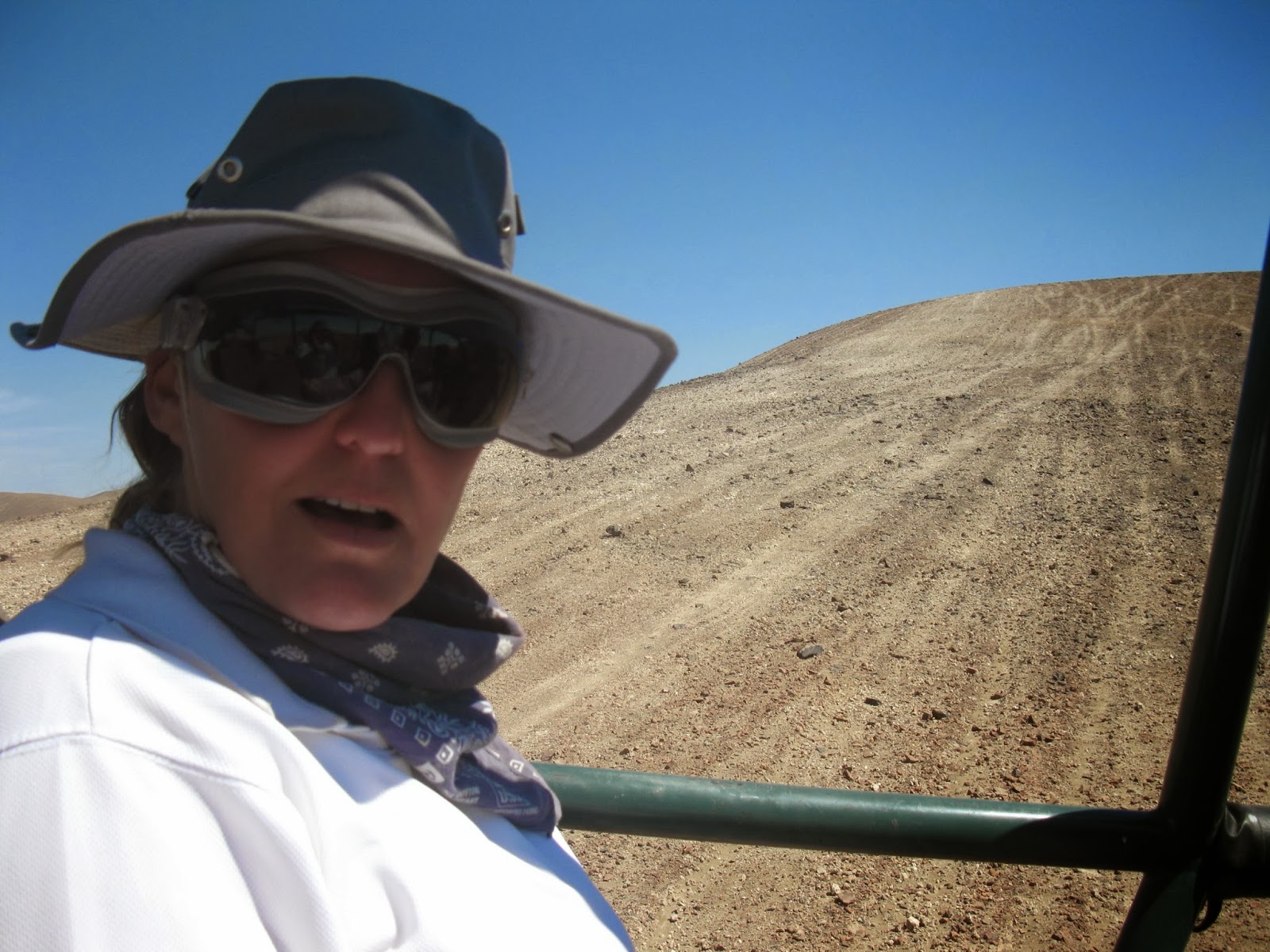
We met Sergio in front of his shop at 10 a.m.  The other person on the trip was a young German man named Roberto.  Sergio handed out goggles loaded our bags and away we go.  We towed the dune buggy to an industrial area were we parked the van and buckled up in the dune buggy.  Hats, goggles and scarfs on, sunscreen globed on, camera out and wrapped in plastic, he says we’re ready.  I felt a bit like a martian.
Sergio and the dune buggy he built

Roberto 

ready to ride


We did “fishtails” around turns through the valley of the dunes, skirting the sides making wakes in the sand.  We topped mountains  to view landscape that touched the clouds.  We saw holes in the dried earth that were once the workplace of men.  They would dig by had 9 to 15 ft down bracing the sides with stones and mud bricks.   There they would  use a bucket to pass up the nitrate they were mining.  In some of these areas it looked like giant gofer holes covering the dry dismal flats of earth.  There were ruins of mud brick structures, the area strewn with remains of their life there.  Pieces of glass,broken dishes, shoes, cigarette papers, newspapers, some with dates back to early 1930’s.
nitrate mine

All the dirt risers are nitrate mines

Then, the cemetery.  This has to be the most desolate place on earth to be buried.  The immediate reaction when coming upon this is such sorrow for these people.  They came here much like the men and women of the gold rush in the west of  the USA.  They came for the nitrate.  A product that changed agriculture,  bringing life to a lifeless soil.  In their end, they were left there in the lifeless soil.  A place that now is only found by GPS and strangers that feel the sorrow of their desolation.  Not even a name on the cross markers to read aloud in respect of their memory and celebration of their life.  A thorough  sadness for me.


To bring us back to the gladness of the day, Sergio took us sand boarding.    Roberto had never done this so it was more fun to watch and listen to him.  He kept calling himself the “chicken German”.  We think not, everybody is hesitant with new things.  He was a lot of fun to have on the trip.

We ate lunch under a camouflage cover offering some shade in an otherwise open air oven.  The wind blew hard in places causing little dust devils.  We saw bones of donkeys that obviously could not make it any further.
donkey bones

lunch spot

lunch spot

Hello Captain Don

dunes that touch the clouds


 It was a great trip tantalizing the imagination for survival. 


Tuesday, December 10, 2013

ANCHOR DOWN Iquique Chile

Anchor down at  20.12.354 S / 70.09.188 W, Iquique , Chile.  We left Lima Peru after four months of incredible, indelible experiences.  (Peru will be posted at a later date) A fine motor sail of 116 hours, uh, nope, we did get to sail 10.5 hours in the wrong direction.  (I prefer going in straight lines, a sail boat does not give that option when going against wind and current.  Given our chosen itenarary, we will be going against wind and current for many more miles.)   So, we have motor sailed a lot, much more than the average sailor.   Captain Don only really complains when he starts seeing the fuel needle move in front of his eyes in between blinking. 

We called the Port Captain about two miles out and received a rather quick response.  We anchored  amongst the tugs and pilot boats.  Next call was to announce anchor down.  Again a quick response with a few questions ending with a stay put, we will be out in 20 minutes.  We did not time them having become quite familiar with “latin time”,  two very young Navy Personel arrived.  They took copies of crew list, boat documentation, zarpe from Peru, and our passports.  They returned a couple hours later with three more people, the police, agriculture, and health agents.  Spanish flying, stamps exchanging, laughs with Captain Don and his stamp, he didn’t want to be left out, me passing the candy bowl around, all visiting officials love and appreciate some type of treat, more laughs and handshakes, we are now almost in Chile.  Because we arrived on a Sunday we would still need to go to the Armada office the following day to pick up our tourist visas and find out how much we would pay for entry.  They did say we could go ashore if we wanted, but having  arrived after 5 days at sea, we really only wanted to eat a meal we didn’t have to chase on a plate and go to bed.

first look at Iquique sprawling doorway to
 the Atacama desert 

cargo ship we anchored close to

The following day dinghy down, we go to marina and speak with Patricio, the manager of Club de Yates Iquique.  He showed us the slip we would be in and viewed the tide tables as to the best time to come in.  This is a shallow bay with many rocks.  We need at least 6 feet at very minimum.  He pointed to the markers we were to line up with to enter, two red triangle shapes mounted on poles, one next to the street, the other down on the rocks. He said just keep yourself  in line with them and we have no problemo.  An agreed price of 12,500 pesos per day including wi-fi, water, and electricity..  We shake hands and off to the Armada Office, a large yellow building standing at the end of the bay and around the corner from the yacht club.

We asked to speak to Carla, the young woman who was on the boat the previous day.  She handed us our tourist cards, good for 90 days, and bid us another welcome to Chile.  She also said we needed to visit the Aduana’s office and the agriculture office.  She found a friend of her’s to interpret directions to both those places and sent us on our way.  While we waited for Carla, another woman, Veronica, approached us and said she would be calling her boss to find out how much we would pay for entry into Chile.  They have set fees for boats of 25 tons or more that pay for entry into each port around $40 US.  We are only 19 tons so she would have to find out.  We told her we would return with a cell phone number she could reach us at when she got the information.  Away  we go to the Aduana’s.  This particular port has many aduana offices and on the third try we found the right one.  Lucky for us the agriculture,  SAG, office is next door.  The aduana office wasn’t quite sure which papers they needed since not many visiting private yachts come this way.  After much deliberation between co-workers it was decided we needed  clearance for our boat.  (Our spanish listening skills still need work).  Copies of boat documentation, passports handed over and we’re now officially in Chile.  The SAG office said we needed nothing more.

A Chilean cell phone sim chip and lunch would now be our priorities.  The young naval officer that had come to the boat recommended the cell company Entel.  He is from Valdivia and gets good signal where ever he has been in Chile.  Easy enough, the plaza has an Entel office and a variety of lunch spots.  Only, this particular office does not sell chips or prepaid plans.  We were directed around the corner and four blocks up.  Ok, off we go sidetracked only a couple of times with lovely hand carved wooden chime clocks, stands with nuts and dried fruits, sidewalk cafes with beautiful pastry counters and coffee aromas that had me salivating as we continued our search for Entel.  Thankfully it was really just three blocks from the plaza.   The person in charge of handing out a number and a line for you to wait in spoke English.  Lucky at last.  He took us directly to a service person and explained what we wanted.  No problemo. 

Now can we eat?  Awe, but where?  Back in Plaza Prat we stood looking at the Torre Reloj clock tower designed by Eiffel and built in 1877 from wood.  A brief stroll on the wooden sidewalks peeking inside establishments, reading any menus posted outside, we settled on a Croatian place that included a glass of wine with the price of lunch.   I thought desert at lunch was special, this place included appetizer, desert,  and wine at lunch.
Torre Reloj Clock Tower, Plaza Prat

we sat outside at this quaint Croatian restaurant, sipping wine indulging in peach mousse, wow.


We made a quick stop at the Armada office to give Veronica our cell phone number and then onto the marina to confirm time and slip with Patricio.  At 18:30 we would bring Limbo in, med moor, anchor off the bow.  There is a small finger pier with cleats and the dock itself is a floating dock.  Tides here average 4 to 6 feet.  With the time left  we’d get in a short nap.


There was some hesitation with the appointed time. We thought it might be too dark at 18:30, but Patricio assured us not to worry.  Back aboard Limbo, we nap a bit and around 5 p.m. a tender to one of the pilot boats knocks on the hull.  A brief exchange of niceties, conversation ensued regarding tides and our being able to enter the marina.  There were 4 fishing boats rafted together in front of the red triangles we were suppose to line up with.  They say their good-byes and again we’re thinking we should go now even though it’s only 5.  All looks good, we line up doing a small diversion to the port of the fishing vessels, passing them and then back on course.  Captain Don maneuvers Limbo to drop anchor, tighten up and stern to the dock.  Patricio and another person caught lines as we churned the water propelling Limbo in place.  I say all this because it then came to our attention there is a two hour time difference in Chile.  They have daylight savings time.  So when we thought we were eating at 1 p.m. it was 3 and at 5 when we thought we were risking a new bottom job, it was 7.  No Problemo.

marina at Club de Yates Iquique

Local fishing boats adding lots of color to the bay

Note on Peru:

The last posting was of our passage to Peru.  I usually like to keep things chronological but because I'm so far behind in writing I will be posting our 4 months in Peru at a later date.  Until then I will post on travels to Chile and our adventures as they occur.  I'm sorry for the confusion, life and fun has kept me busy.

Stay Tuned Please.

Sincerely,
RB

Friday, November 22, 2013

PASSAGE TO PERU

Bye bye Ecuador and hello Peru!  Excitement unbridled, we were like small children heading to Disneyland. Peru, land of the Inca, Machu Picchu, the Nazca Lines, alpacas, and the upcoming country in the world of gourmet food.  Also one of the countries on my bucket list.  We left Salinas, Ecuador at 11:35 a.m. July 15, 2013.  (yes, I'm still behind in postings)

I will admit to some trepidation because of the direction we would be attempting to sail.  We would have wind and the Humboldt current against us. The plan was to sail the first part as far as we could and then motor in.  We only hold 90 gallons of diesel in the tanks and then carry another 30 gallons in jerry cans on deck.  The trip was suppose to be approximately 708 nautical miles.  This would equate to 6 or 7 days passage time. I had prepared several meals and froze them insuring we'd have plenty to eat regardless of the weather conditions.

The first few days went against our plans requiring us to motor sail much more than intended.  The winds where at a 20 to 27 knots, seas varying from 8 to 12 feet.  At times it seemed we were going backwards! Captain Don had chosen the sailing route because of requirements to check into Peru's maritime vessel traffic controllers, "Tramar". Check in is 24 hours prior to arriving in Peruvian waters, and then two times daily giving position readings until arriving in your port of call.  This is usually done via internet.  We had intended to use SPSMAIL, which is associated with our Iridium Satellite Phone. Awe, the path of good intentions. Our computer crashed making email impossible.  The four phone numbers we had for Tramar, no one answered regardless of time of day or even what day. The only other thing we could do to try and comply was travel close enough to shore to use the VHF radio, channel 16.  Time and time again to no avail, zero response. We continued to call and document the call time with position and station we tried to contact.  We then tried contacting our liaison from Seven Seas Cruising Association to see if he could help with our entry.  Ugh!  He was out of the country.  We did reach his wife and she notified the yacht club of our pending arrival.  This did not give us check in approval for Tramar.  Worry, worry.  There could be heavy fines imposed.  Nothing to do but keep documenting the endless effort of contact.

We are now testimony to why this is a route less traveled.  We ran through unmarked fish nets that extended a mile or more with very small unlit vessels to tend them, which by the way do not show on our radar.  Some of the boats did have a single pole with a red light stuck to the top of an outboard motor, but when the waves are taller than the light, there goes any benefit! We got caught once and spent an hour trying to just float off without damage to their net or tangling Limbo's prop.  The second time I ran right through it, not sure of the damage done to the net, Limbo kept plowing through making use of the favorable night wind.  We now changed watch schedules to every 2 hours.  Dangers do lurk off the northern coast of Peru.  Day three we had no choice but to head out and start tacking to catch some wind and conserve fuel. Again high seas, steady 25 knot winds with gust to 30, (this would not be that bad if it wasn't head winds). We continue tacking, day 4 winds calmer, no more fishing boats.  Dolphins arrived to give a show, leaping with the bow wake, skirting under the boat on the other side, so fast they're but a streaming black color under the blue green sea.

Day 5 we're still tacking.  Time dragging.  Moods waning.  Sea and wind still touch and go.  You would think that with all that free time something wonderful could become of it.  That is not what happens.  On a passage of any length, you read, you play games, you sleep and you eat.  For us, night watch is usually 3 hours.  This of course depends on the weather.  With this trip, a watch was only 2 hours, day and night.  So you're on a sleep deficit.  Even on the days where you can get in a 4 to 6 hour sleep, you're still operating on a deficit.

Day 6, we are really getting concerned about fuel.  We should be closer than we really are.  It seems Lima is getting further away.  It's demoralizing when that happens, but when you tack out to catch the wind, then tack back you are traveling a zig zag line in the ocean not a straight freeway.  This adds more miles. More dolphins come to give us much needed cheer. The weather was changing to a cool crisp feel.  We pulled out the sweatpants and blankets for the nights watch. Winds still hitting 27 knots, waves still rock and roll, pitching us back and forth. Nauseating and annoying.  Around 11 p.m. we heard a snap, actually a bit louder than a snap, we lost the jib. Captain Don made quick work of furling it in hoping for nothing else to happen in those moments.....By 4:30 a.m. winds were acting like they might calm down. Daylight we slowed off the coast outside of Semanco, close to Chimbote, to inspect the damage to the jib. Bad news, the webbing on the head of the sail was ripped.  No can use.  This meant a motor sail with only the main the rest of the way, another 205 nautical miles to go. Fuel rapidly depleting, we crossed our fingers and prayed.

Later with sun setting, a full moon rising, we see the arid shoreline with the Andes towering on our horizon.  It's these moments that answer the quest for adventure.


78 miles left to go, winds down to 17 knots waves down at 8 to 10 feet gently rolling.  A lift and slide, not a pitch and slam.  The passage was  getting better. 46 miles left, waves calmed more, winds down to 14 knots.  6:39 a.m. July 23, 2013 we arrived at Port of Callao, Lima Peru.  We were greeted by a launcha (water taxi) sent out by Yacht Club Peruano.  We have landed after 8 days of one of our toughest sails to date.  It felt good to be here.


Sunday, November 10, 2013

BOAT LIFE ON THE HARD


Still in La Libertad, Ecuador with Limbo hauled out receiving some exterior painting and interior woodwork.  The yard we were in was also the yard preferred by the local fishing vessels.  They are mostly wood and look massively heavy.  We had one hauled out next to us and since I couldn't walk with my sprained ankle, I took to spying on the neighbors.

They start with chainsaws and cut huge pieces of the wood hull away.  They move onto sanders that sound like jet engines stripping the paint to bare wood. They send in a professional crew to strip, patch, and paint. Before caulking is done, they use coconut fiber (the hair that covers the interior nut) and twist it into a rope then hammer that in between the new planks.  The wood used is "al camphor" which is brought in as logs that they cut into planks the size needed for replacement. It is amazing that the boats were floating with what they do.  

coming in for a haul out.

weighted down with nets


chain saws finish the removal of rotten planks
making cuts for the chainsaw

no more stern!
twisting coconut fiber
hammering coconut fiber in between the planks

Amazing work and quite fast.  The boat was stripped and repaired within two weeks.  It took a month for ours.  Maybe we should have used a chainsaw.....

For us, living on the hard was a little like living in a house under construction.  There are certain areas that can't be used, and when you only have a few hundred feet every little bit can add up to ALOT of space.  There is dust everywhere, water can't be used because of paint, so you wash dishes in a bucket outside.  Showering and toilets are used elsewhere so you try not to wait too long. And like a house, when the work is finished you can't wait to clean up and move back in to all the new beautiful space.
wood trim for windows, fishing pole rack & table top using the same
camphor wood

Work done, back in the water and ready to leave Ecuador.  Next up in our South American circumnavigation, PERU.

Saturday, October 26, 2013

Moving On....

Time to be moving on.  We had been in Bahia, Ecuador since March 9, 2013.  We have traveled inland for several weeks leaving Limbo on a mooring at Puerto Amistad Yacht Club.   We went back to the states for 6 weeks to visit family and buy winter clothing for our journey south.  We still had one more stop to make in Ecuador, La Libertad.  We had heard it was a great place to haul out and get some work done.  We left the mooring lines at Bahia at approximately 12:30 to make the high tide at 2:00 p.m.  It's a rough entrance and exit.  The bay itself where we were moored all that time is also quite rough with as much as a 3 knot current bringing with it treasure trash from the Rio Chone.  It would be nice to be in the ocean and underway again.
Bahia, were Limbo was moored
The depth sounder started acting odd, we hit hard going out, maybe that jarred it out of commission!

In less than 24 hours we were pulling into La Libertad, Puerto Lucia Yacht Club, June 6, 2013. A boat came to greet us, pick up the captain of the vessel and pointed to a temporary anchorage to wait while our papers were processed.  When arriving in a port, custom dictates only the captain goes ashore until the vessel and crew are cleared in.  In a few of the countries we've been to, it is mandatory that you hire an agent that clears you through all the agencies at each port, Ecuador is such a country. Rumors were rampant about La Libertad because of the seemingly unregulated agent in charge. It was said he charged what ever he wanted.  Usual agent fees can be anywhere from $50 to $450.  This agent had been known to charge as much as $1000.  These fees are on top of what the country charges for clearing a vessel in and out.  We had been in contact with him via email letting him know of our anticipated arrival date.  On our way out of Bahia, Trip, the owner of Puerto Amistad phoned us and said that the agent in question had died two days prior.  He had hung himself.  Not knowing what to expect, we kept going.  Come to find out, no one knew what to expect, we were the first private vessel in port since his death.  There were no other agents for private vessels.  The owner of the yard, Marisol, took all our papers, the marina took our credit card, then directed us to a marina slip with that timeless phrase, "don't worry". Good news, we were told we could haul out the next morning for work to begin.

Following morning up and about.  We wanted work to begin on Limbo as soon as possible because we only had one month left on our visas for Ecuador.  We were excited to be getting solar panels, davits, a table, paint job, bottom paint, and sail covers.  New to the list now was the dept sounder. During the work we had planned on finishing our tour of Ecuador, seeing the south end of the country.

First disappointment, the yard manager, Jeremy would be in Florida for a few days which would delay our haul out and placement in the yard.  Not a problem, we would catch up on some much needed cleaning with the fresh water supply offered at the dock.  Also shop in regular grocery stores where the food comes in packages and cans.  You know, the American diet....  I know this probably does not sound very exciting to most of you, but, the word grocery does not have the same meaning in other parts of the world.  Cans, bottles, clean, sterilized, sealed products are not the norm.  Shelves with 20 choices of mayonnaise are not available.  Country of origin for your meat is not really necessary because you can look out the back door and see the food chain grazing on whatever they can find.  When you first encounter this, it is "organic on the cheap". After a few months of it, the thought of a box of fruit loops is salivating.

A week passed, the plans still in play for traveling and the wish list for Limbo growing, we had the most extraordinary experience.  The famed blue footed booby bird of the Galapagos perched himself on the rocks right next to us and a sea turtle surfaced.  I wondered if they were friends that had become lost together.
Blue footed Booby

yep, definitely blue feet

sea turtle

And then the second disappointment, I missed a very small step twisting my ankle.  It looked bad, really bad and hurt.  In hindsight, I should have taken a picture.  This ended the traveling, I would not be able to walk for quite a while and even then it would be a hobble.

Plans continued for the haul out and work on Limbo.  Out of the water and in place with our stern facing the ocean, I at least had a lovely view as I lay in bed watching my ankle change colors. Then the third disappointment, Jeremy, the yard manager informs us that the only way to get bottom paint for an aluminum boat is from the USA.  This was going to be very expensive with the 18% duty Ecuador charges for anything being shipped in, not to mention the time lag because paint has to be sent by boat.  Bottom job now off list.  Searched and searched for aluminum tubing to make davits, no go.  Davits now off the list.  Search for solar panels, no luck.  Same story with the fabric to make new sail covers, special order, long delivery time, import tax.  No new sail covers. We had the paint on board for the hull, so that was done.  The wood work took the entire month. We were concerned that we would have to leave without it.
sunset view
I've always had a passion for rock collecting and the beach here is a fantastic place to add a good variety.  Captain Don found a rock hammer for me and sent me hobbling along.
looks like an agate I had to have it

my first hammer job!  I loved it
Between my ankle and waiting for work on the boat, our adventures were limited to the neighboring beach front, the mall with a Carl's Jr. hamburger stand, and a gringo bar where a number of expats could be found.  They also served black Angus beef steaks on Tuesdays!   During my convalescence I took a few private Spanish lessons hoping to improve my conversational comprehension and Captain Don took some time to fish.  

 All in all, not a bad way to spend your days.