Thursday, August 8, 2013

Cuicocho, the road to your soul


I believe the last place I left you was in Otavalo Ecuador a lovely, colorful and crowded place renowned for their Saturday artisans market.  Not far from there is a lesser traveled attraction called Laguna Cuicocho also called Lago del Cuy (Guinea Pig Lake) named for the largest island in the lake believed to look like a guinea pig.  It is approximately 650 feet deep, 2 miles wide, at an altitude of 10,650 feet located in a crater at the foot of  volcan Cotacachi.  There are three domes of volcanic rock that form two islands rising from the center of the lagoon, Yerovi Island & Teodoro Wolf Island. These two islands have a channel between them called, “channel of dreams”.
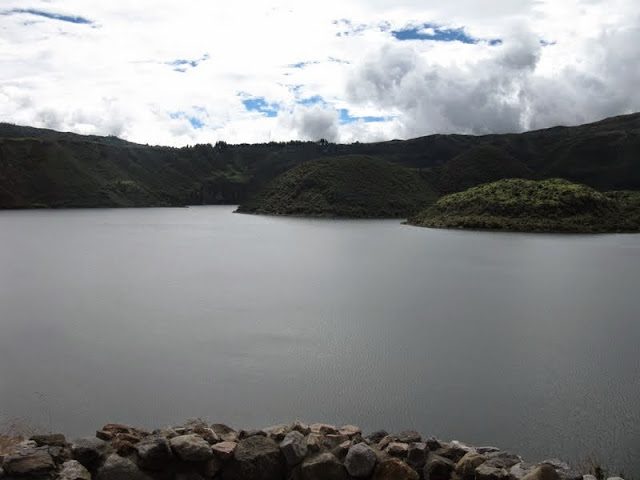
Yerovi and Teodoro Wolf Islands


There is no known outlet for the lake and it has such a high alkaline level little life survives.  Only the Silvery Grebe bird which lives on the vegetation just below the surface and the banks of the lake.
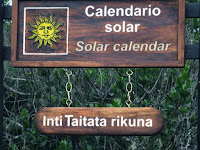

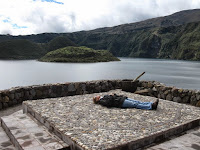
There is a small park on the lower rim with a trail taking you through the history of the lake as it was used by the indigenous Quechua.  The lake is still used today every summer solstice (Inti-Raymi) by shaman for ritual cleansing and purification.


 The trail took us through some of their other practices as well.  We thought they sacrificed people so Captain Don was getting ready.  Only they prepared food.  I hope our Spanish gets better.
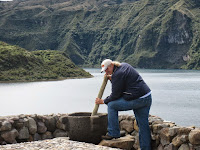
stone cauldron

he only thinks I'm going to do this!

 The perimeter offers a challenging 8 miles hike taking about 4 to 5 hours to complete if you are so inclined. We made about 3 miles and decided breathing would be a better option, so we headed back to the restaurant for beerthirty.  (higher altitudes take a lot of getting used to)
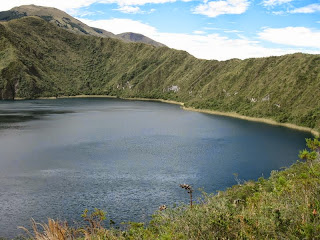
rim as you can see goes up!


This was such a beautiful view looking away from the lake you see the valley of Otavalo as it spreads from populated to farming.  The area is surrounded by other volcanos; Imbabura, Cayambe, Cotopaxi, and Cotacachi. Spectacular.  You are in the clouds, we were calling them "Homer Simpson" clouds, they're so incredibly cartoon white and the sky so blue.
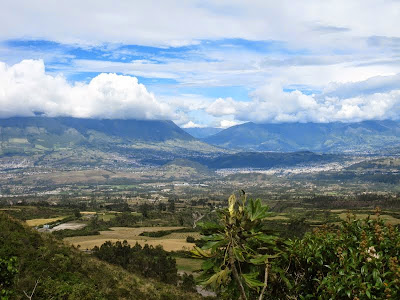
Otavalo Valley

Cotacachi one of the only snow capped mountains in Ecuador

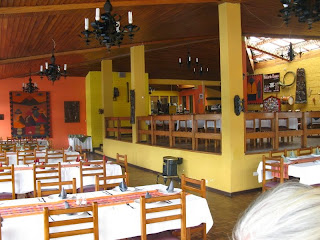
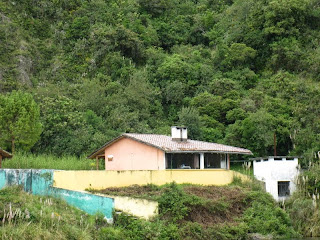
There is a quaint restaurant serving local cuisine and a hostel that has a cabin on the side of the mountain.  After seeing it, I wanted to move in, unpack my computer and pretend I was a famous writer living in seclusion producing a life changing manuscript! 
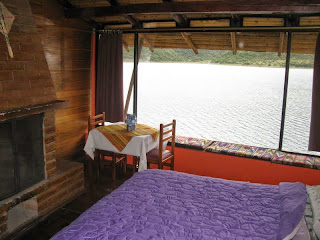

fireplace, table, cushioned
window seat overlooking lake, room service, wooden walls and floor, beams made from cedar and bamboo.  Eclectic, rustic, possibly a bit feng shui, none the less warm and very welcoming.

view of room from other side of the lake

restaurant
Staring from my window seat at the snow capped mountain, the lake, the blue of the sky, was certainly captivating.  I began to feel a change, to see this place God made, and I was given a personal invitation.  It was experience of freedom that  comes from the inside.  A release from gravity, not only terrestrial but all the pulls of life.  A freedom to see what is before you in that moment, your senses are alive guiding you from one wonder to the other. I cannot describe it as delight, thrilling, or tranquil.  It was more a loss of all thoughts, there was no discord, no needs or fears.  There was something within that was aware of unity and oneness.  There is a God, and He has made an indelible memory for my soul.


There is beauty in different forms, places, people. There is something for all of us, shared and special.


Sunday, July 7, 2013

Higher and Higher we climb

We're back!  We had a fantastic six weeks at home visiting family and friends.  We even managed a biker rally in Banderas, Texas, close to San Antonio.  We can now cross that off the bucket list.  Sleeping in a tent, in 50 degree weather I have to admit was not that much fun.  However, the ride through hill country is beautiful.
The tent was furnished with an air mattress and one blanket!

Sign over the cash register were we stopped for breakfast.


We packed our bags with everything we could think of for our return to Ecuador.  Mostly boat parts and warm clothing.  The seasons here are opposite.  We went home for spring and would now be returning to winter.  It was quite difficult saying good-bye again.  As much fun as it is to travel it is very difficult to say good-bye to your family.

Eyes dried, we took out the travel itinerary for the next 15 days.  We landed in Quito around 10:30 p.m. caught a cab, found the hotel and crash landed.  It's close to 13 hours travel time from East Texas to Quito.  Then the altitude of ten thousand feet to adjust to again.  The itinerary was timed too close for much rest.  First thing on the list was to book our trip to the Amazon, then find a clinic to get a yellow fever vaccination.  We had tried to get one in the states but the pricing was outrageous.  We were able to get one in a private clinic for under $40 for both of us, plus they gave us an international health card, good for the rest of South America.  Back to the hotel to repack taking only our backpacks for the next few days.  (The hotel we were in had luggage storage available.)  Not sure if we were feeling jet lag or some effects from the vaccination, we were tired and opted for the restaurant next door to the hotel.  What a surprise!  A fabulous place serving Swiss cuisine and lovey red wine. We should have skipped the red wine.  Don looked up some of our symptoms on the internet when we returned to our room and we were not suppose to drink for 10 days after the vaccine.  OOPS! 

The following morning off to the bus station, destination Otavalo, a quaint little town known throughout the region for their Saturday market.  A short two hour bus ride we arrived just before lunch.  Fortunately the hotel allowed early check in and then suggested a restaurant.  Lunch done we found a taxi driver to take us to the "Condor Park" just a few miles up the mountain outside of Otavalo.  The Condor is the national bird of Ecuador and the park, according to the brochures, had a flying time at 4:30.  Pretty exciting, we were going to see this bird up close and in flight over a valley soaring from a small park on top of a mountain 11 thousand feet up.  Majestically owning the sky, catching the wind with an outstretched wing span of 9 to 10 feet.  (that's 2.5' to 3' taller than Captain Don) I was feeling the grandeur of it when we arrived at the gate only to be informed that they would not fly the birds that day because of the weather.  WHAT?  You've got to be kidding!  and some other things said we still entered the park.  Then it rained.  And rained.  And rained some more.  We scooted from cage to cage viewing, snapping pictures of what we could, but the condor did not come out of his cosy, dry home.  We did see some gorgeous birds including our national bird the bald eagle.  The most impressive for me was the harpy eagle.  
Harpy Eagle

Bald Eagle


Our taxi driver had waited, thank goodness.  Maybe he had been through this before, knowing that it wouldn't take more than 30 minutes to view the park in the rain.  A park employee must have felt bad for us because he brought us a very large umbrella to use during our visit.  Back down the mountain to Otavalo and the hotel, dry warm clothes and a nap!  It poured rained the rest of the day.   

Up early to the famed artisans market of Otavalo.  The cab driver  from the day before had suggested we first go the the animal market just on the other side of the bridge.  Taking his advice we headed there first.  Mud, poo, mud, poo, skinny cows, pigs on leashes, goats being herded, chickens and ducks held upside down by the feet, burlap sacks wiggling on the backs of the indigenous as they somehow made sense of the auctions taking place for the different species.  Horses looking bored, the people lively, animated, and some quite serious looking for just the right specimen.  Whether they were intent on eating their purchase or adding them to the farm stock I do not know.  It was enlightening to see this way of life.  Can you imagine going to an animal auction for your future dinner?  The funniest was the women haggling over the price of guinea pigs.  Guinea pigs are quite common in the Andes providing a high protein food that requires little care or feed and reproduces rapidly.  They call them "cuy". 
cuy for dinner?


animal market


Lunch?
We hoped as we were leaving to find a rain puddle with enough water to rinse our boots!  The artisans market was in full bloom when we arrived.  I say bloom because the colors were as vibrant as nature, a primary colors kaleidoscope surrounding the horizon.  Life buzzing, every one's finest being displayed.  The stalls decorated with fabrics, paintings, carvings, leather goods, pottery, beads, hats, blankets, hammocks, shoes, scarves, the list goes on. I didn't know where to begin.  There were rows and rows, street after street.  I wondered if this was where the retail stores in other parts of the country came to buy what they would resale.  I think maybe.  It soon started looking all alike.  
market
thread they make those wonder sweaters with

market


We walked away with another 100 pictures and a scarf! Time still left in the day we took a cab for a road trip of the area.  This led us to an area of legend covered with a spiritual shroud and snow.


Saturday, June 1, 2013

Colonial Quito

Still in Quito you say?  Yes, it is a huge city with stuff.  Lots of stuff.  After living and traveling on a boat, cities are fascinating to me with all the hustle and bustle of traffic, horns, lights, smells, cab drivers and buses, languages foreign and more foreign.  Everyone with someplace to go, things to do, and we were no exception.  We had touristy things to do before we headed to the airport for our anticipated trip home.  

Quito is divided into districts so it's fairly easy to get around and map out your day.  An entire day was devoted to the historical center, or old town of Quito.  If you like old buildings, this city was awarded the First Cultural Heritage of Humanity and American Capital of Culture in 2011.  It's over 5 centuries old.  I won't bore you with descriptions but some of the churches here are unbelievable.  One of them took 160 years to build and has over 52 kilos of 23 carat-gold leaf adorning the walls and statues.  There is a painting in one called the "Hell and the Last Judgement" by Brother Hernando de la Cruz from 1620.  A massive work of art depicting the "breaking of the big 10 sins" people standing in judgement in hell,waiting.  The colors and activity in that painting alone could keep you standing there for hours.   Most of these places you're not allowed to take pictures.  One of the churches has an 1104-pipe organ that is still used for special concerts.  The streets throughout this part of the city are brick, the buildings multi-colored and adorned with more carvings and ornate iron work than anywhere I've ever seen.  Some of the tile work is interlaced with the back vertebrae of animals giving white geometric symmetry to the tile stones.  Take a stroll through Old Quito with a few photos:  


Look at the church at the end of the street.  I wanted to go but the hills had become too much.


Hell and Last Judgement

What a great few days we had here.  Now it's time to get on a plane and head back to Texas for a few weeks.  Adventure awaits there too.

Bahia Caraquez to the Middle of the Earth - Quito

Good day to all of you. We've had adventure after adventure the last few weeks, so I'm a bit behind in the blog updates.

 First a bit about our entry into Ecuador. We had been told to not try and enter your first time into Bahia Caraquez without a pilot. On our approach it was apparent why, with huge boulders piled onto the beach, and jetting up through the shallows, a current sending us backward and winds taking us sideways.
the nav aide, yep it's on dry land at low tide

 We had sent an email letting the owner, Tripp Martin, know of our anticipated arrival date. We anchored in what they call the "waiting area" overnight for a pilot and high tide in order to enter the channel leading into the bay and marina. Twenty dollars and 3 cold coca colas got us safely in and secured to two mooring balls, one aft and forward. It was rapidly apparent why we needed two moorings as the current is 3 knots with lots of debris washing down the Rio Chone. Logs, trees, masses of grasses that looked like small islands, all wrapping themselves around the mooring lines and Limbo momentarily encasing us in jungle rubbish as the current carried it out to sea. The marina is not really a marina, more a restaurant with some mooring balls they rent by the month. They also provide a dinghy dock, laundry facilities, and the indispensable, wi-fi. This is a less expensive entry point with the Marina Puerto Amistad being owned and operated by an ex-sailing gringo. He doesn't charge the exorbitant agent fees that are charged at the other entry point in Salinas. People tend to leave their boats here for long periods of time while they do inland travel. Which is exactly what we intended to do. The town of Bahia is not much to talk about except that it is a weekend resort town for people from Quito and beyond. It is quaint with it's daily markets of fresh produce and fish, comfortable and safe to walk around in to get off the boat a bit, and some fairly decent restaurants. The lunches being the best. You can get a bowl of soup, a meat with rice, salad, plantains and fresh squeezed juice for $2.50. Some come with a desert and then it's $3.00.
fresh produce and fish daily
We left Bahia and Limbo behind and headed up into the Andes, to the capital city of Quito approximately 10,000 feet above sea level, and home to over 3 million people. The bus ride was luxurious compared to others we've been on, complete with English subtitled movies. We could feel our lungs struggle slightly, the air thinner and cooler as we traveled higher.
10,377 feet according to the smart phone.
After a 7 hour ride, the bus let us out in what appeared to be a congested intersection, not a bus station. Shrugging our shoulders with a look of confusion towards one another, we picked up our backpacks and hailed the next cab. Turned out we were only a few blocks from our hostel, the L'Auberge Inn, owned by a Swiss couple. A very cute place, good food, very friendly English speaking front desk help.  Unfortunately, we had to climb a lot of stairs to get to our room which did not help our heaving, wheezing, lungs.  No TV, no heat, but some great alpaca blankets, wi-fi, hot water shower, and decent food.  Of course when you took a shower, the time between water to clothes was exceptionally cold!  Not to complain, we were going to be too busy to worry about our room with the rock hard bed and flat pillows.  Our intent was to do some volcano exploring.

The following morning we took a cab to Teleferico which is at the base of volcan Pichincha.  There you can take a gondola ride up to the clouds, or 13,400 feet.  The view is spectacular with all of Quito spread through the valley surrounded by mountains and two other volcanoes, Cotopaxi and Cayambe.

gondola to the clouds
Quito from the clouds


The view was a bit obscured because of the clouds but beautiful none the less.  We decided that we would definitely need more time to acclimate to the altitude before we ventured any higher or on any hikes.


Next on the list of things to see and do, Mited del Mundo, or middle of the world.  A monument made from volcanic rock and museum marking the supposed equatorial line.  It has quite a display of equipment used by the first French Geodesic Mission in 1736 who came to measure an arch of meridian to prove the shape of the earth.
Mited del Mundo


The true equator is down the road just a few miles with another museum called "Inti-Nan" or "Path of the Sun".  This site was the one claimed by the Incas as the center of the world and has been verified using GPS technology.  Amazing isn't it?   How did they know?  
First we sailed across, now we're standing on the line of two hemispheres!  Incredible when you're there.


Some of the experiments they show like, how your balance is different, how an egg can stand on a nail head, how water circulates in different directions depending on what side of the line your on.  All impressive stuff until someone tells you its a hoax.  But, we did see these things with our own eyes 
Captain Don trying to make the egg stand by itself.
the egg does stand, but some else did it.


This little museum is packed with local lore including how to shrink heads which according to the guide, was allowed all the way to 1950 when it was outlawed for human heads but continues to be done on animals in some of the remaining jungle tribes.  The walls depicted paintings showing the steps.
Step 1 cut off the head

Step 2 take out the skull


Step 3 sew the lips together and add secret herbs.  (they don't tell you which herbs, its ancient secret, if they told you, they'd have to cut off your head)
Step 4: Boil the head
Step 5: If the person was a loved one or person of importance they would decorate it and wear it.  If it is an enemy, you get put on a pole or hung in a tree.

This is a real shrunken head kept in a glass case.  The guide said it was of a 12 year  old  boy. (I have been called gullible more than once)


Enough for now, we have more on our stay in Quito to share another time.