Monday, January 27, 2014

Peru-- Part II --Lima, Mira Flores, Huaca Pucllana, and Mistura


LIMA
    city of roughly 11 million people.  There is a perpetual grey fog over the city and surrounding area for months at a time.  I heard one say it was the grey of a donkey’s belly.  That would describe it fairly well.  We arrived July 23, 2013 and left November  25,2013, almost the entire winter season for South America.  During that time it was cold, wet, and grey.  Don said it reminded him a bit of Seattle except no rain. It rains less than half an inch per year in Lima.  The pollution is high giving the buildings a black dust or greyish film layer.  This does not distract from their elegance and grandeur.  The architecture and colors here are awe inspiring. 

We saw the changing of the guards at the Palacio de Gobierno also known as the Presidential Palace, a lengthy process. We went two times and did not stay from start to finish either time.  It is colorful and something you should do as long as you are there.
changing of the guard
they dressed up the dog to come watch this daily event


The Convento de San Francisco is part of the Iglesia de San Francisco and houses a library of over 22,000 leather bound books and parchment scrolls going back to the early 16th century. The knowledge and beliefs recorded on these documents and books blasted my imagination.  These hand covered leather journals, written with quill and ink representing the authors opinions of life and God.  The meaning of it all (the universe) being discussed and written.   I doubt they had it figured out any more than we do. (No pictures were allowed in here.)  The monastery also houses crypts that were not discovered until 1951 and contains the skulls and bones of over 70,000 people.  It was creepy to walk through them.  The monks would bury people one on top of the other using lime in between to keep down the smell.  Some of the crypts are for one family line, some are singular for famous benefactors, others are for the masses.  One in particular, a large circular brick crypt contained over 25,000 bodies. 
Iglesia de San Francisco 

grate in floor looking down at a crypt (pictures were not allowed in the catacombs)


The Museo de Inquisicion- This was the headquarters of the inquisition for the Spanish from 1570 to 1820.  It contains the original tribunal room and the dungeons complete with torture chambers.  This place was the judge and jury for anyone committing crimes against the Catholic Church.  These crimes could be an accusation against the church, a lie, anything against the church.  Horrible deeds were done to people here. 
judge & jury - original desk used

the rack to stretch you apart

looks like waterboarding 

me -  this was a cell they would keep people in for months at a time.
MIRAFLORES  a modern 21st century suburb of Lima.  The parks, shops, all rival those found in the USA
view from the park

park

Larco Mar Mall, built into the side of a cliff


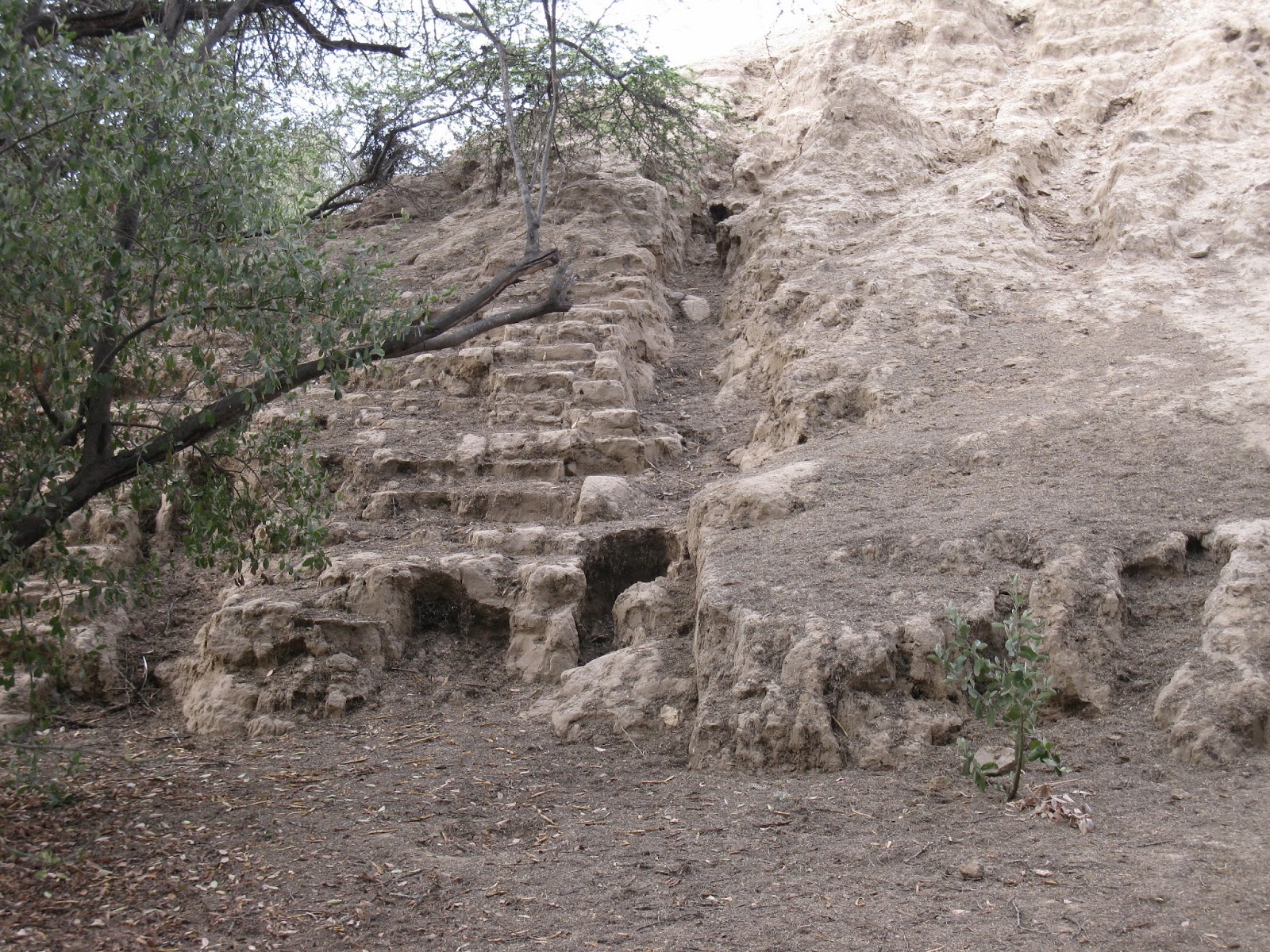
In the heart of Miraflores lies Huaca Pucllana.  It has a hollow core running through its cross section and is believed to have originally been built in the shape of a frog, symbol of the rain god.  It is said that he spoke to them through a tube connected to the cavern.  This site is very touristy due to its location. There are many replicas of the people and their labors placed throughout the excavated areas.  The bricks here are placed vertical lending less space in between giving more protection from earthquakes.  The guide said that the place was rebuilt by the inhabitants every 15 to 20 years placing the new ontop of the old.  To date they have discovered 3 different cultures that occupied the site.


notice the bricks

our friend Fiorella helping make a brick

MISTURA:  The largest food show of any kind we have been to.  This place was a mecca of anything and everything Peruvian.  We went on a week day morning when they opened at 11 a.m.  The line was already quite long.  Thousands of people attend this week long event.  It show cases the pride of Peru, its food.  There are over 3000 varieties of potatoes, over 2000 varieties of avacados.  I have no idea how many types of corn, but many.  Not only do they showcase food but Pisco, a grape brandy, the national drink.  We ate and drank from 11 a.m. to 7:30 p.m.  We had managed to collect a set of glasses from the Pisco we drank but then I forgot them in the cab!  That is still upsetting.  The more pisco the better my spanish!  Don danced with a devil woman wearing snakes and I was filmed on live T.V.  A great day sampling the food and people watching. 
the line before opening

potatoes, reportedly over 3000 types exist in Peru

the breads are super delectable

barbeque the next longest line

this
 is a sweet potato

watermelon roses

does he look nervous?  the head to the 2nd snake is looking at his hand behind her

delicious

soap bubble hug


We also spent Captain Don’s birthday in MiraFlores with Don’s brother Ron who had come from California just in time for the big event, and our new friends Gonzalo and wife Magdala Ravago at a restaurant called El Mercardo.  Gonzalo ordered several dishes giving us a wonderful sample of the menu.  We do not know which was better, each offering it’s own uniqueness. 

happy 60 Captain Don


Sun setting we crossed the bridge and entered the village of Barranco to meet up with our friends from La Punta, Fiorella and Frank.    It had been awhile since we enjoyed the night life of a bar, live music and dancing.   We found a local place that claimed to have live jazz.  NO.  It was live, but certainly not jazz in any language.  The area of Barranco is known for its entertainment and the place was quite crowded. Although we did not notice anyone much over 30.   We left and walked around a bit ending in the plaza.  There Fiorella stood center stage and sang her version of Marilyn Monroe’s Happy Birthday to Captain Don.  A heartfelt fun way to end the day. 
Fiorella and Frank, friends from La Punta

Ron and Don, "the on brothers"

Fiorella singing happy birthday 

One of the things Don had wanted before leaving Peru was to eat Cuy, the furry little animal we know as the guinea pig.  While brother Ron was with us we traveled into Lima for some sightseeing and cuy.
I did not taste it but I do not think it tasted like chicken.


 Lima, the city with the grey veil.  Underneath lies the heart beat of a country alive within its legends, boundless in its quest for greatness.


Continued in Peru  - Part III –  The coast of Paracas to Nasca and Huacachina, the desert Oasis

Saturday, January 11, 2014

Peru, Ancient People, Myth, Legend, Centuries Old Ruins, Pisco, & Ceviche - Part I Chiclayo the North


Part I: the North – Chiclayo and surrounding area

Peru, a country we traveled from north to south and the Andes in between, leaving only the jungle unexplored by us.  (We had seen the jungle while in Ecuador, see “We survived the Amazon”)  We wanted to visit pre-Inca civilisations, their architecture, and learn of their culture.  Nowhere is there more of this than in Peru.    Mexico and Central America have the Mayans, Peru and South America have the Incas. 

It has been an amazing journey sailing Limbo from New Orleans to Lima.   Not many sailors come this far south, for several reasons,  the primary one being head winds.  Very stubborn, strong head winds.  No one likes to sail an extra 400 miles tacking back and forth just to pull into a port that then charges them an exorbitant amount of money to enter their country.  They also tend to threaten you with fines for not adhering to particular guidelines made up as they please.  Had it not been for the Seven Seas Cruising Associations liaison, Gonzalo Rivago, we would have been at their mercy.  This is not so for land travel or people entering by plane.  There are quite a few people that leave their boats in Bahia Ecuador and travel by bus or plane to Peru.  The offset to the government officials is Peru itself.  A country filled with generous friendly people, and lets not forget the food.  Do not come here if you are worried about your waistline.  

Peru has been on my bucket list for quite some time as a place to visit and we both had dreamed of Macchu Picchu.  There is so much more than Macchu, although that is a highlight.  We started our adventures with a bus trip north of Lima, to the bustling city of Chiclayo.  This is primarily a commercial area but also used by tourist as a staging point to visit the sites of TÙcume, SipÃn, Lambayeque, and Batan Grande.  Chiclayo also has a central market famed for its section devoted to  mercado de brujos (witches market) selling everything from herbs to whale bones and the famed San Pedro hallucinogenic cacti. 

We arrived rather early with plenty of time to drop our bags and book a tour.  We got lucky with Sipan Tour company for pricing and a private guide with car.  We were able to make our own schedule with sites we wanted to see.  We went first to La Pimentel,  a small beach community that still uses the traditional caballitos del mar (made from totora reeds) boats for their small fishing industry


 Over the next two days we visited the archaeological sites of SipÃn , Sican, Tucume, and the Bosque de Pomac  a dry forest,  as well as the  Museo de las Tumbas Reales de SipÃn and Museo Nacional de SicÃn and Museo de Sitio.  Tùcume is also known as the valley of the Pyramids with over 26 adobe mounds to walk to.  The dry windy conditions and earthquakes, has left many of these structures looking like large mounds of packed dirt with some crevices and remnants of steps.  Looking closely, bricks could be seen, imaginary rooms with walls, etc.  Much to learn, some quite confusing as to who conquered who and when.  The cultural differences seem to be in their ceramics, religious idols, crafts and burial preferences.  Some were buried laying down, some sitting up.  All seem to be buried with their possessions to take into the after life.  The area was first inhabited by the Mochica where the Temple of SipÃn was the main burial pyramid for the nobles, then SicÃn who built in the BatÃn Grande area abandoning it after a disastrous rain in 1100 AD.  They then moved to Tûcume.  Then came the Chimu people, the Inca, and then the Colonial period.  I think this is the order of it.  A few references,  three museums, and one guide have a little different story for each.  They all furthered  civilization with textiles, ceramics, metallurgy, agriculture, and boat building techniques we continue to learn from and build on.  Of the area we saw, I believe the dry forest was my favorite. 


noble found buried sitting upright with his wife, concubines, child and 2 guards

 Burial Note:  When the husband dies, his wife and his concubines are sacrificed and buried with him.  If the child is under 14 years of age, they too are sacrificed and buried.  The guards are also killed and their feet cut off so they have to stay to protect the tomb for all eternity.  Our guide, Arturo said they were given juice from the San Pedro Cacti and then killed. 


1000 yr old tree and still growing


Arturo told us of a time when he went to Brazil it started to rain.  He had never, yes, never in his life seen rain.  His friend gave him an umbrella and told him to put it over his head so he would not get wet. He was confused as to why people were laughing and staring at him.  He had not opened the umbrella but held it above his head with it closed.


fallen bridge
  When the governor came for the opening ceremony, the bridge collapsed when the first car went over.  The driver had to be rescued and sent to the hospital.  He then was arrested and sent to jail for breaking the bridge.


We spent three days touring the area and went to continue our way to Trujillo.  While waiting in line for a bus ticket, my backpack was stolen, in it my clothes, computer, planner, guide book, and my travel diary.  Yes, I know a few paragraphs back I said what a wonderful people the Peruvians are.  They are.  I don’t want to sully mine or your view with one bad incident.  However, with no clothes, we returned to Lima to regroup and replace things I needed.


Continued Part II

Thursday, January 2, 2014

First week in Chile

The sun is shining and I’m wondering why?  I had looked at my watch and it said 4 a.m.!  Awe, yes, three hour time difference, it’s really 7 a.m.  But wait, the sun is still so incredibly bright.  After four months in Lima, dark had become our day and night.  This was a splendid change even at the early hour. 

We had many things on our “To Do” list.  First was to get pesos, then back to the phone company.  We discovered we had internet for a little while but then we didn’t and we were not able to make calls.  I will not complain, it is still easier to deal with cell phone companies in any of the countries we’ve been to over the ones in the United States.  Agenda day one: Entel, Zofri (a duty free zone), grocery store, laundry, book store.

There are countless banks here in Iquique some of them international.  This was a huge mining town in the 19th century for nitrate and copper.  There are also a few abandoned silver mines dating back as far as the late 1500’s.   They now have a large fishing industry that ships fish meal around the globe and in 1975 they built the “zona franc” locally called zofri.  It is a massive duty free shopping zone offering anything from cars, clothes, electronics, tools, and toys, etc.  As a tourist you can spend a little over $1000 US and not be taxed. 

Pesos, no problemo, rate of exchange posted in front, sign clearly marking the line and cashier to get change.  All that you need is a passport which we did not have with us, but, they excused it this time and cashed in our dollars.  Next the phone.  The same English speaking young man standing in the same place we’d left him the day before.  There is still no problemo,  dial 123 + country code + area code + number and you can reach anybody anywhere.  OK, we tried it while standing there and hey it does work.  Next, the internet, awe yes, he explained that we had been given 50MB for free and now we had to “activate” the service to deduct money from our balance to turn on the internet app.  How civilised, if only we would have known that the day before….. For the rest of the time in Chile we should not have to do anything else except keep a positive balance.  He said if we have anymore problems come back. 

Zofri next stop.  Taxi cab let us out in front of a metal store front with glass doors.  Inside, is an immediate shock of surprise.  There are three levels with lights flashing, singing, swirling,and pulsating every color in a prism.  Corridor upon corridor there were shops.  Some specializing, some eclectic.  We walked and looked, walked and looked, soon undone with sensory overload.  We went outside and discovered a checkpoint line requiring a ticket and passport for entry.  This was the real Zofri.  The front we were in was the mall, this next area was the actual duty free zone.  We did not have passports on hand so we left for lunch.
We were looking for a particular book, “The Atlas Hidrografico de  Chile”.  Our information said that all the armada offices had them, or Chilean consulates, or bookstores.  We were on the search to no avail.  We did find a marine store, the laundry, and several grocery stores called “Uni-mac".  We found the tourist office called Sernatur .  Fortunately, one of the personnel, Aaron Baruch,  is fluent in English.  We were able to ask a 100 questions.  He gave us maps, info, and restaurant suggestions.  We had also been searching for a man named Sergio Cortez.  We had read he did aluminum welding.  We still wanted aluminum pipe for davits to hold the dinghy.  The tourist office knew of him because he also does extreme sports tours, company name Civet Adventures,  www.civet-adventure.cl


We found our way to Sergio’s and although he did not have any aluminum pipe, he was able to give us a name of someplace else to try and we booked a dune buggy trip with him for the following day.  We then took a cab to the Las Americanas Mall, still looking for the atlas.  There we found the Hiper Lider, (pronounced Heeper Leeder), a rather large grocery store, a Sodimac which is the US equivalent of Home Depot, and another mall.  A cursory tour of all three places we left without our book but terrific goodies for dinner.
The dune buggy tour would be off road using only GPS to navigate through the Atacama desert,the only desert in the world that does not recieve any rain.  The desert brings challenges that most of us would not ever want to face.  There are however the extreme sport enthusiats that trek across this vast waist land on foot http://www.4deserts.com/atacamacrossing/location_culture . We would be seeing abandoned settlements from the nitrate miners as well as the mines, and vegetation that grows off the mist of the night air.

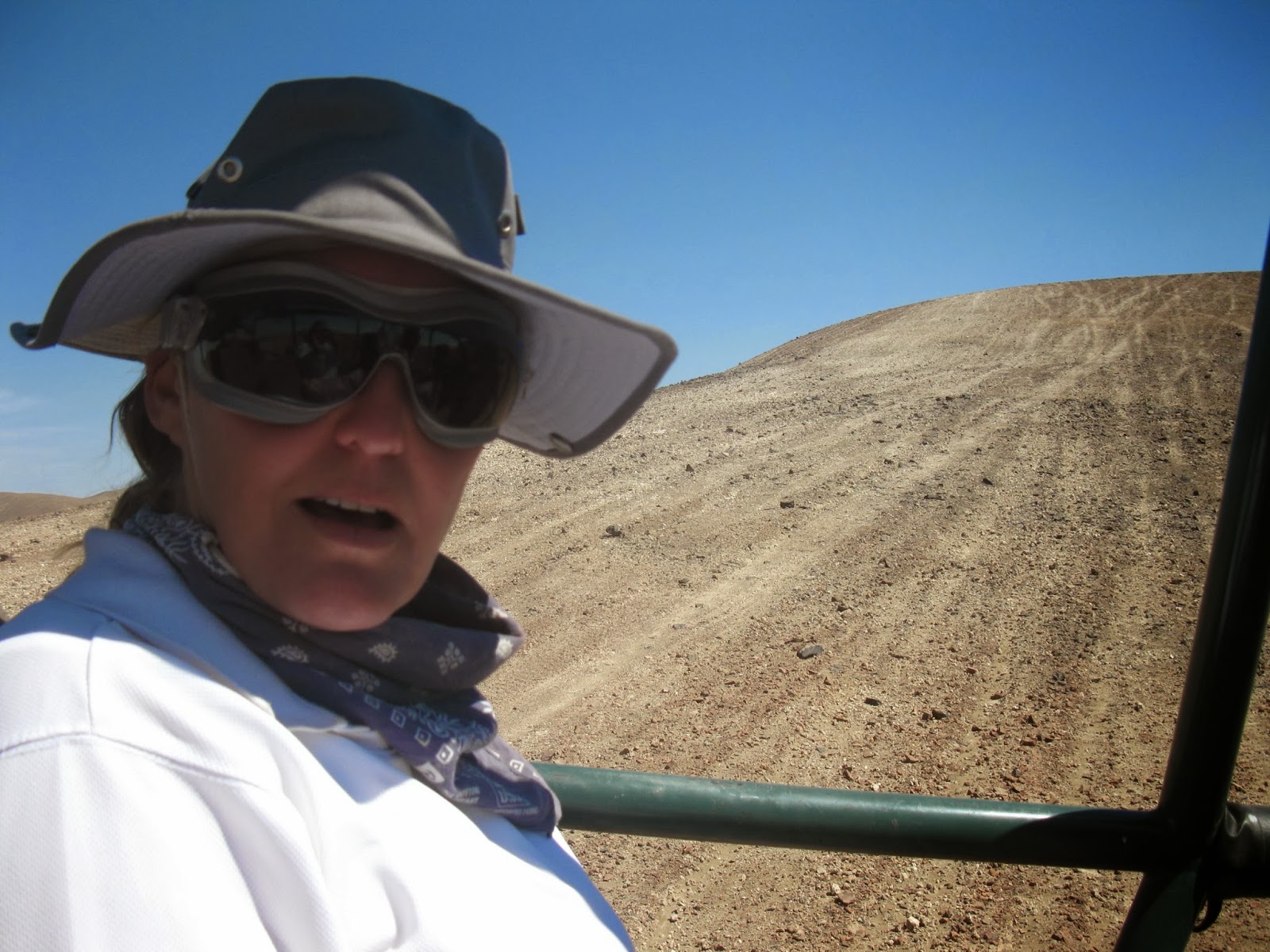
We met Sergio in front of his shop at 10 a.m.  The other person on the trip was a young German man named Roberto.  Sergio handed out goggles loaded our bags and away we go.  We towed the dune buggy to an industrial area were we parked the van and buckled up in the dune buggy.  Hats, goggles and scarfs on, sunscreen globed on, camera out and wrapped in plastic, he says we’re ready.  I felt a bit like a martian.
Sergio and the dune buggy he built

Roberto 

ready to ride


We did “fishtails” around turns through the valley of the dunes, skirting the sides making wakes in the sand.  We topped mountains  to view landscape that touched the clouds.  We saw holes in the dried earth that were once the workplace of men.  They would dig by had 9 to 15 ft down bracing the sides with stones and mud bricks.   There they would  use a bucket to pass up the nitrate they were mining.  In some of these areas it looked like giant gofer holes covering the dry dismal flats of earth.  There were ruins of mud brick structures, the area strewn with remains of their life there.  Pieces of glass,broken dishes, shoes, cigarette papers, newspapers, some with dates back to early 1930’s.
nitrate mine

All the dirt risers are nitrate mines

Then, the cemetery.  This has to be the most desolate place on earth to be buried.  The immediate reaction when coming upon this is such sorrow for these people.  They came here much like the men and women of the gold rush in the west of  the USA.  They came for the nitrate.  A product that changed agriculture,  bringing life to a lifeless soil.  In their end, they were left there in the lifeless soil.  A place that now is only found by GPS and strangers that feel the sorrow of their desolation.  Not even a name on the cross markers to read aloud in respect of their memory and celebration of their life.  A thorough  sadness for me.


To bring us back to the gladness of the day, Sergio took us sand boarding.    Roberto had never done this so it was more fun to watch and listen to him.  He kept calling himself the “chicken German”.  We think not, everybody is hesitant with new things.  He was a lot of fun to have on the trip.

We ate lunch under a camouflage cover offering some shade in an otherwise open air oven.  The wind blew hard in places causing little dust devils.  We saw bones of donkeys that obviously could not make it any further.
donkey bones

lunch spot

lunch spot

Hello Captain Don

dunes that touch the clouds


 It was a great trip tantalizing the imagination for survival.